
Quick Answer: A situationship is a romantic or sexual connection that has intimacy but no label, no commitment, and no consistency. It lasts months, runs hot and cold, and leaves you more anxious than secure. If you’ve been seeing someone 2+ months without clarity, it’s not a talking stage anymore—it’s a situationship.
A situationship is modern dating’s most painful purgatory.
You’re more than friends, less than partners. You act like a couple on Tuesday, and then you don’t hear from them until Saturday.
You have deep talks, maybe you sleep over, maybe there’s genuine care—but no commitment, no clarity, no security.
And you can’t leave because the good moments feel so good. Even if the anxious in-between feels awful.
If you’re in one, you’re not stupid. You’re not desperate. You’re caught in what psychologists call intermittent reinforcement—the same psychological hook that makes slot machines addictive.
It keeps you chasing crumbs and thinking it’s a meal.
This article is part of our Modern Dating Hub and connects to our guides on the talking stage, anxious attachment, and the no-contact rule.
–

–
What Is a Situationship? Definition
Situationship = a romantic and sexual connection without a clear definition, commitment, or consistency.
Usually, one person wants more, while the other wants the benefits without the responsibility.
Key traits:
- Intimacy (emotional and/or physical) but no label
- No clarity on exclusivity, future, or expectations
- Inconsistent: hot and cold, close then distant
- Lasts months, not weeks—it’s a talking stage that never got defined
- One person (usually the anxious attacher) is more invested
How it’s different:
Talking stage vs. situationship: The talking stage is early—weeks—and it’s normal for it to be unclear for a short time. The situation is stuck.
Friends With Benefits (FWB) vs. Situationship: FWB is clear.
Both people agree it’s just physical, with boundaries.
A situationship is ambiguous. One wants more; the other likes the attention without committing.
That’s why it hurts more.
7 Signs You’re in a Situationship—Checklist
- No Label After Months
You’ve been seeing each other 2+ months, and you act like a couple, but when you ask, “What are we?” the answer is “I don’t know, let’s not ruin what we have” or “I’m not ready for a label.” - Future Faking
They talk about future trips, meeting family, and “when we get a place…” but they never make an actual plan. Words about the future, no actions in the present. - The Hot and Cold Cycle
Super close for 3 days—texts, affection, deep talks—then distant for 4 days—dry texts, excuses, no plans.
That cycle keeps you anxious and chasing.
- You Feel Anxious More Than Secure
You check your phone constantly. You analyze punctuation. You feel high when they text; you crash when they don’t.
Your nervous system is dysregulated, not in love.
- You Do Couple Things Without Couple Security
You cook together, you meet friends sometimes, you sleep over, and you support each other emotionally—but there’s no commitment, no exclusivity, and no “us.” - You Abandoned Your Own Boundaries
You told yourself you wanted commitment, but you settled for less because you were scared to lose them.
You tolerate breadcrumb communication you’d never tolerate from a friend.
- Your Friends Say “Just Leave” But You Can’t
Those intermittent good moments feel addictive, though.
You keep thinking, “If I just show I’m chill enough, low-maintenance enough, they’ll choose me.”
If 4 or more are true, you’re in a situationship.
–

–
Why Situationship Hurts So Much—It’s Not Drama, It’s Neuroscience
It’s not you being dramatic. It’s intermittent reinforcement.
- Consistent love = secure, predictable dopamine. Calm.
- Intermittent love (sometimes loving, sometimes distant) = supercharged dopamine chase. Your brain thinks: “If I try harder, I’ll get the good moment again. “So you try harder. You abandon yourself more.
This hits anxious attachment hardest because your attachment system already fears abandonment.
A situationship confirms that fear: “See, if I ask for what I need, they pull away. I must be too much.”
Also, you’re grieving a relationship that never officially existed but felt completely real.
That grief is valid. Don’t let anyone tell you that you can’t mourn something that wasn’t “official.”
Why Anxious Attachment Gets Stuck in Situationships
I’ve seen this pattern over and over in our community:
- You confuse anxiety with chemistry. Butterflies feel like attraction, but often it’s just anxiety. Real security feels calm, not chaotic.
- You believe love must be earned. “If I’m chill, low-maintenance, not needy, they’ll choose me.”
- You fear asking for clarity will make you lose them, so you settle for crumbs instead of asking for the meal.
- It feels familiar. If you had to earn love growing up, a situationship feels familiar—not healthy, but familiar.
A secure person would ask for clarity around week 6 and leave if there was no alignment.
Anxious, she stays for months hoping.
This situation is not your fault. But it is your pattern to heal. See our guides on [anxious attachment] and [self-worth after a breakup].
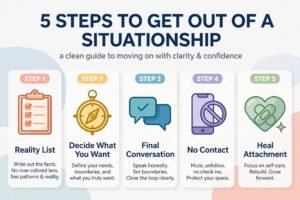
How to Get Out of a Situationship—5 Steps
–
–
Step 1: Get Honest—Reality vs. Fantasy List
Get a paper. Two columns.
Fantasy: “They’ll commit if I’m patient enough; they’re just scared. Deep down, they love me.”
Reality: “For X months, they’ve shown they don’t want commitment; they enjoy my company without responsibility.” I feel anxious most of the time; my needs are not being met.”
Read the Reality column every morning for 7 days.
Step 2: Decide What You Want (Not What They Want)
Answer honestly: Do you want a situationship or a committed relationship?
If you want commitment, a situationship is not aligned with that—no matter how much you like them as a person. You’re not asking for too much.
You’re asking the wrong person.
Step 3: Have the Final Clarity Conversation—One Time
Say this once. Mean it:
“I’ve really valued our time together. I’ve realized I want a committed, defined relationship with mutual investment, not a situationship. I’ve enjoyed what we had, but staying in this in-between is hurting my peace and taking me away from what I want. I need to know: Are you open to exploring a committed relationship with me in the next few weeks? If yes, let’s talk about what that looks like. If no or you’re not sure, I understand, and I need to step back completely to heal and move on. I care about you and I need to care about myself too.”
Then stop. Don’t negotiate. Don’t explain more. Their answer—or non-answer—is the answer.
Step 4: Leave If It’s Not a Yes—Implement No Contact
If the answer is not an enthusiastic yes with action, it’s a no.
Script to leave:
“Thank you for being honest. Since we’re looking for different things, I’m going to step back from contact to heal. Please don’t contact me unless you genuinely want to talk about commitment. Wishing you well.”
Then the full no-contact rule: 60 days minimum. Mute. Archive. No stories. No checking. Tell mutual friends not to update you.
Yes, it will hurt like withdrawal for 2-3 weeks. That’s normal. It will pass if you don’t redose.
Step 5: Heal the Attachment Wound
A situationship leaves a hit to self-worth.
Do the deeper work:
- [Self-worth after breakup]—values, boundaries
- [How to get over someone]—Box method, Reality list
- [Anxious attachment healing]—self-soothing, building a secure base within yourself
- Journal prompt: What did this situationship teach me about what I will NEVER tolerate again? What green flags will I actively look for next time?
What If They Come Back After You Leave?
–

–
They often do. You leave, they miss your attention, they breadcrumb: “Hey, I miss you; I’ve been thinking about you.”
Rule: Only consider it if they come back with a clear, committed plan:
“I realized I was scared. I’ve thought a lot. I want to try a committed relationship. Here’s what I’m willing to do…”
If they come back with “Hey, how are you? Want to hang?” “—That’s not change.
That’s loneliness. Don’t reply, or reply neutrally: “I’m taking space to heal; I need no contact.
Wishing you well.”
When Can a Situationship Become a Relationship? Rare, But Possible
Only if BOTH of these are true:
- The situationship was short (under 2 months), and both people were scared but willing to grow
- Both do the work: talk about attachment, boundaries, fears
- The person who was avoidant shows consistent action over 4+ weeks, not just words
- You feel secure, not anxious, after the shift
Most situationships that last 4+ months do not become healthy relationships—the pattern is already set.
Your self-respect is a better investment.
You deserve clarity, not confusion. Commitment, not crumbs.
FAQ
Q: What is a situationship?
A: Intimacy without commitment or label, lasting months, often hot and cold, where one person usually wants more than the other is willing to give.
Q: How long do situationships last?
A: On average 3-6 months, often ending when one person wants clarity and the other doesn’t.
Beyond 3 months without a label, it’s no longer a talking stage—it’s a situationship.
Q: Why can’t I leave a situationship?
A: Intermittent reinforcement creates an addictive loop—the good moments feel extra rewarding after anxiety. Anxious attachment strengthens it.
You need a reality list and full no contact to break the loop.